
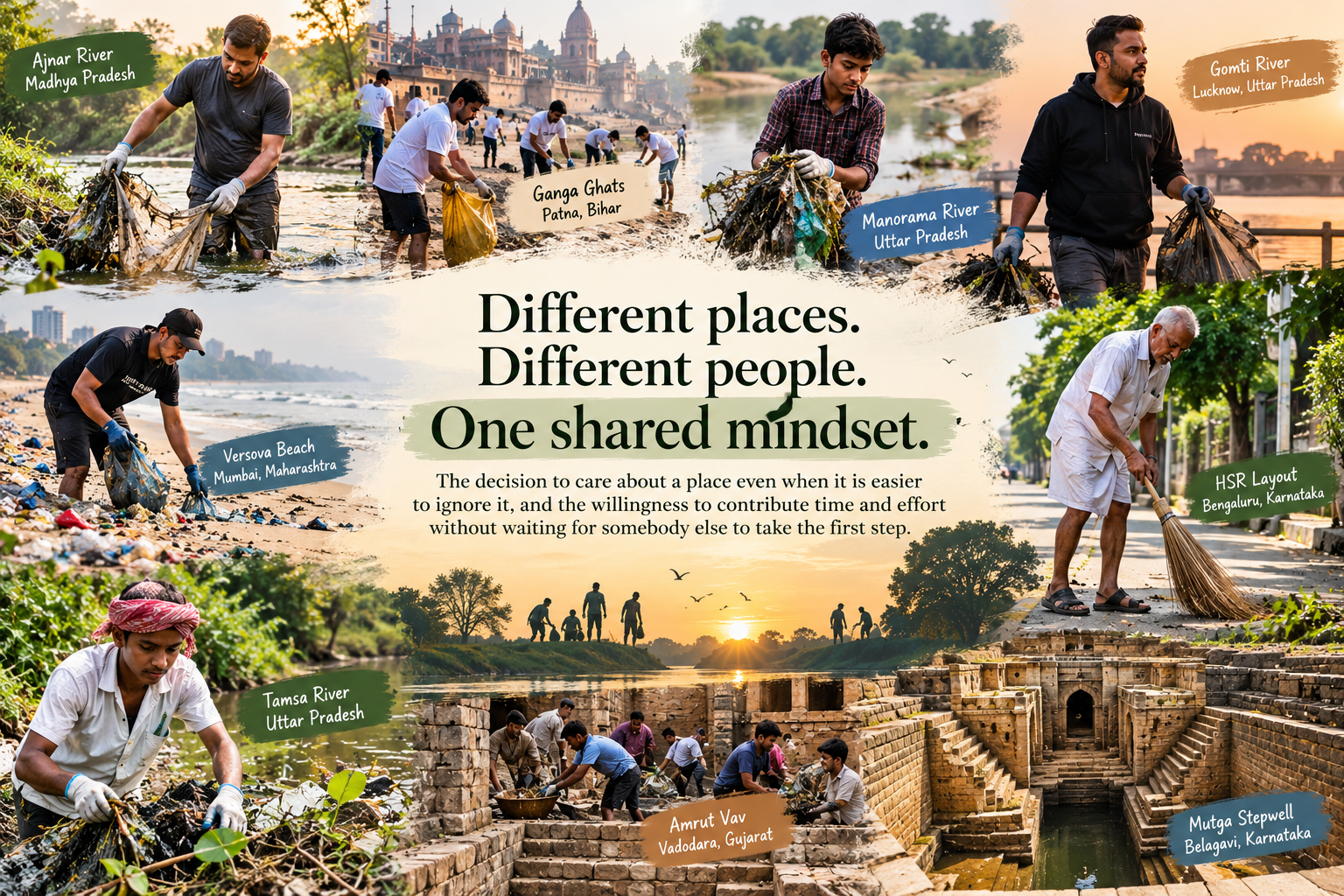
Look closely at these stories and you will see that they are not all the same. Some people work on rivers. Others restore beaches, care for neighbourhood streets or bring forgotten heritage sites back into view. Some begin alone; others build communities around a common goal.
Their timelines matter, too. Afroz Shah’s beach clean-up began in 2015, Shubham Kumar’s work dates to 2018, and Go For Gomti began in 2023. These initiatives were already underway before Bittu Tabahi began cleaning the Ajnar River in 2026. Their stories should be recognised on their own terms—not presented as though one person started or inspired them all.
The common thread is a mindset, not a movement with a single founder. It is the decision to care about a place even when it is easier to ignore it, and the willingness to contribute time and effort without waiting for somebody else to take the first step.
The people who clean should not have to keep cleaning up after everyone else
We should celebrate people who remove rubbish from rivers, beaches, streets and heritage sites. Their work deserves recognition. But we should be careful not to turn their dedication into an excuse for everyone else.
A river should not need a young volunteer to remove the waste we throw into it. A beach should not depend on a handful of committed people to repeatedly collect discarded plastic. A resident should not have to spend years sweeping a street because essential civic services are unreliable. A historic stepwell should not have to disappear beneath garbage before people recognise its value.
Volunteer clean-ups can remove existing waste and inspire change. They cannot, on their own, replace effective waste collection, sewage management, civic maintenance or public accountability.
Not littering is not an extraordinary act of environmentalism. It is a basic responsibility.
From everyday cleaning to a wider culture of care
At LOCI, we believe that cleanliness is not just about the moment something is cleaned. It is also about the choices we make every day.
A clean home, a clean street, a clean river and a restored stepwell are very different things. They require different methods, resources and expertise. A household cleaning product cannot solve river pollution, restore a heritage structure or substitute for a city’s waste-management system. Those problems need their own solutions.
But there is a connection in the way we think about cleanliness. We make choices about the spaces we inhabit every day: how we maintain our homes, how we use products, how we dispose of waste and how much thought we give to what happens after we have finished using something.
This is the mindset we want LOCI to stand for: cleanliness as a practice of care, not merely a task to be completed.
For us, that means developing cleaning products with attention to the ingredients we use and the choices we make as a brand. It means being thoughtful about environmental claims rather than making promises that cannot be substantiated. And it means recognising that a more responsible approach to cleaning is part of a wider conversation—not a substitute for the work of environmental volunteers, civic bodies or communities.