
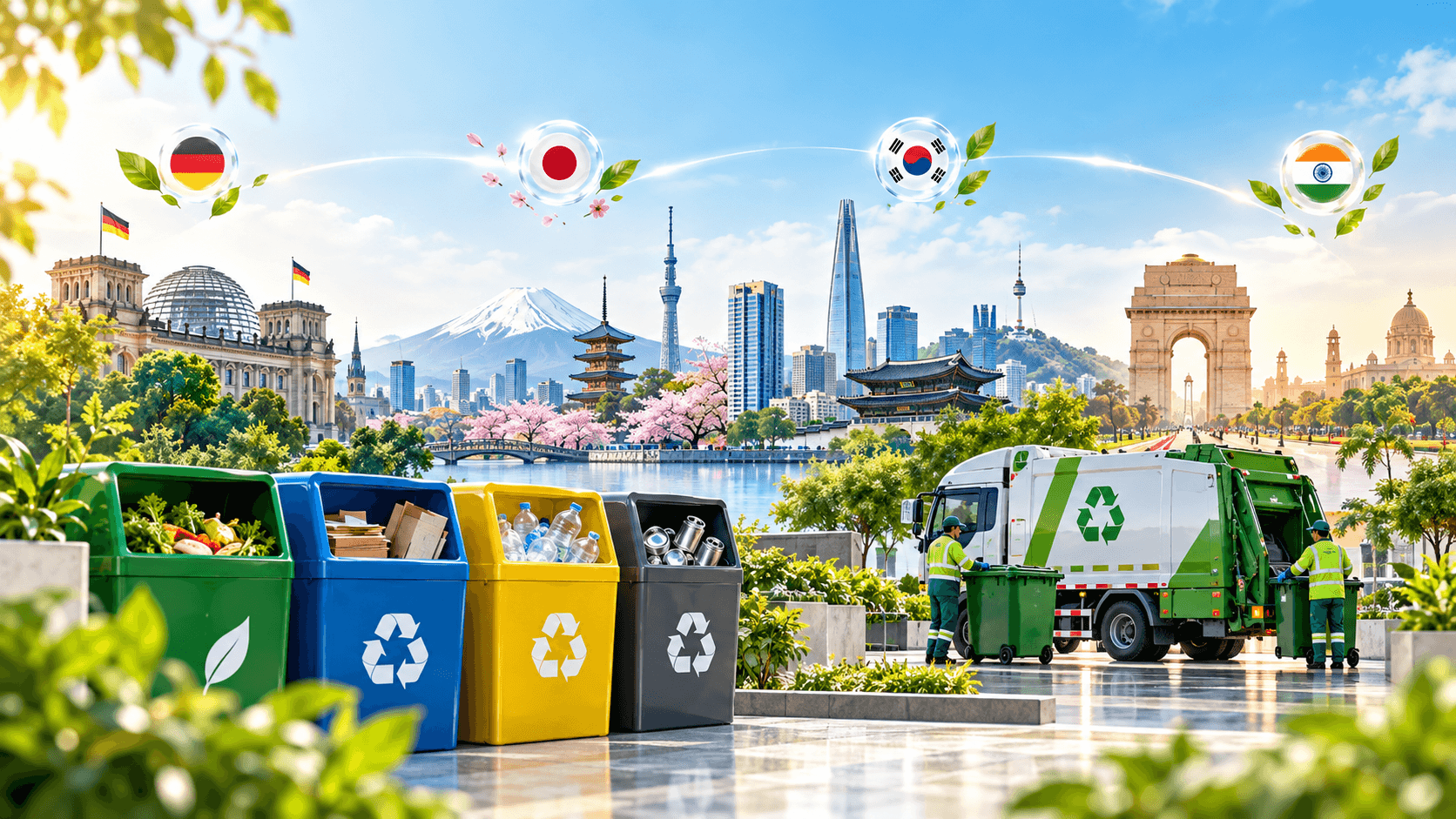
How clearer sorting rules and dependable collection can make waste systems work better
Introduction
A household throws away vegetable peels, a cardboard delivery box, a plastic container and an empty glass bottle. All four items may be placed in the same bin, but they are not the same kind of waste. Food scraps can contaminate dry recyclables, while glass, paper, plastic and special-care waste may need different collection and treatment routes.
This is why waste segregation is one of the most important steps in building a cleaner and more resource-efficient community. It is not the whole solution, but it helps create a clearer path for materials to be reused, recycled, composted or disposed of appropriately. Germany, Japan and South Korea offer useful lessons, although no country’s system can simply be copied without adapting it to local needs.
Germany: Make sorting part of daily life
Germany’s waste system uses separate collection streams for materials such as paper, glass, packaging, organic waste and residual rubbish. The underlying principle is that waste should be separated before different materials become mixed together.
This can help preserve the quality of recyclable materials and reduce the amount of mixed waste handled as residual rubbish. Clear collection points and familiar categories can make sorting part of ordinary household routines rather than an occasional activity.
The lesson for India is not that every locality needs identical coloured bins. It is that categories should be understandable, instructions should be easy to find and collection should be dependable. Residents need to know what is accepted locally, where it goes and what to do with items that do not belong in everyday recycling.
Japan: Clear rules and predictable collection
Japan’s waste disposal arrangements are managed locally, so sorting categories and collection schedules differ between municipalities. Residents may be given detailed instructions on how to separate materials, which days particular waste streams are collected and how to dispose of bulky or special items. In some areas, rules are quite specific, reflecting the local collection and processing system.
This highlights the importance of clear, accessible information. People are more likely to follow a process when they know what goes where, when waste is collected and how special items should be handled. Consistency also matters: residents need to trust that separated waste will be collected according to the announced schedule.
For Indian cities and towns, the useful lesson is to make local instructions simple to access and practical to follow. Apartment notices, ward-level information, collection calendars and clear labels can reduce confusion. Rules should be explained in the languages people use and updated when arrangements change.
South Korea: Treat food waste as a separate stream
South Korea offers a useful example of food-waste management. In Seoul and other areas, programmes have included dedicated food-waste collection and systems that charge households according to the amount or weight of waste disposed of. The details vary by location and programme, but the broader approach treats food waste as a distinct stream rather than simply another part of mixed rubbish.
Separating food scraps can support treatment options such as composting or other processing routes where appropriate infrastructure exists. It can also make the scale of food waste more visible and encourage households to think about what they throw away. However, separation alone does not guarantee a beneficial outcome; the collected material must be processed through a suitable system, and contamination needs to be managed.
The wider lesson for India is that food waste deserves attention. Vegetable peels, leftover food and other suitable organic material should not automatically be mixed with plastic, glass and paper. Households can reduce avoidable food waste through better meal planning and storage, and follow local guidance on whether scraps should be composted at home or placed in a designated wet-waste stream.
What should India adopt?
India cannot simply copy another country’s system. Cities and villages differ in population density, infrastructure, collection capacity, local markets and household practices. A workable approach needs to reflect local conditions while keeping a few core principles in view.
First, segregate waste where it is generated. Keep wet waste separate from dry recyclables and follow local rules for sanitary and special-care waste. Batteries, electronics, chemicals, medicines and sharp items may require dedicated handling rather than ordinary household disposal.
Second, make collection dependable. Segregation loses public trust if different streams are immediately mixed during collection or transport. Local systems need suitable vehicles, trained workers, clear schedules and oversight so that separation at home leads to appropriate handling later.
Third, give people clear instructions. Use simple guidance for food scraps, paper, plastic, glass, metal, sanitary waste and household hazardous waste. Avoid confusing residents with inconsistent instructions across buildings and collection teams.
Fourth, make recycling practical. Materials need a reliable path from collection to sorting and processing. Informal waste workers already play an important role in material recovery in many places; improvements should recognise their contribution and support safe, fair working conditions.
Finally, encourage participation and accountability. Residents, businesses, waste collectors, housing associations and local authorities all have responsibilities. Feedback mechanisms can help identify missed collections, unclear rules and recurring contamination.
Do not wait for someone else to begin
A household can start by setting up separate containers and learning the collection rules that apply locally. An apartment association can communicate those rules, coordinate with its waste contractor and check whether separated streams are actually being collected as intended. Shops and offices can review the waste they generate and provide clearly marked bins where appropriate.
Local authorities must provide the infrastructure and oversight needed to make participation worthwhile. Segregation is not the entire answer: reducing unnecessary consumption, reusing materials and preventing litter are important too. Nor should responsibility be placed only on households when collection and processing systems are unreliable.
Cleanliness is not achieved when rubbish disappears from view. It is achieved when waste is handled responsibly from the moment it is generated to its final recovery or disposal.