
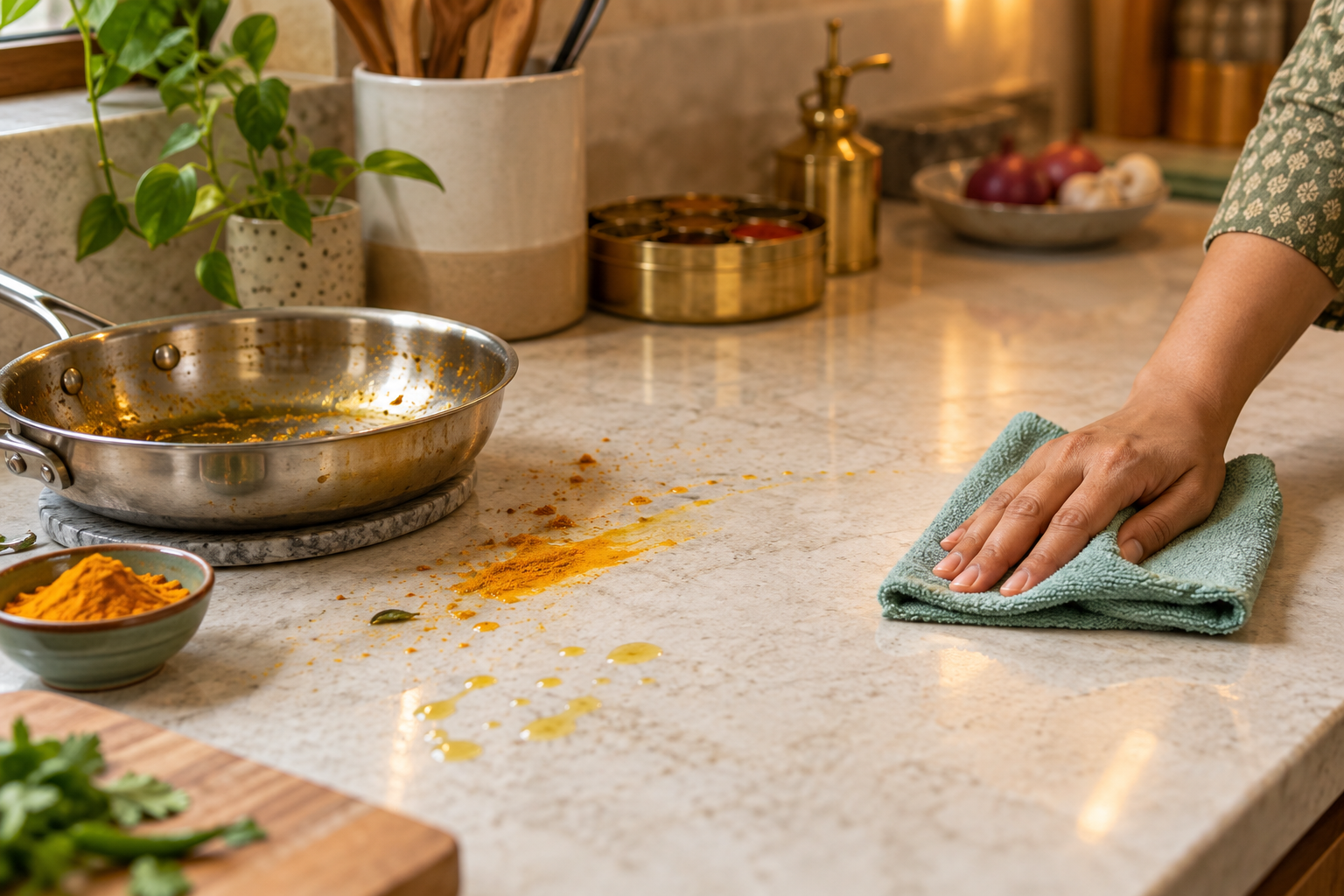
A little haldi on the counter, oil splashed during tadka or a ring left by a masala bowl can make an Indian kitchen look messy in minutes. These marks are not all the same. Turmeric leaves a strong yellow pigment, while tadka often leaves a thin, sticky film of oil and spice particles. The most effective approach is to remove the excess first and then clean according to the countertop material.
The instinct to scrub harder is understandable, especially before guests arrive. But aggressive scrubbing or an unsuitable chemical can damage a polished finish, laminate, coating or natural stone. Quick, careful action is usually a better starting point.
Start with the surface, not the stain
Granite, marble, quartz, laminate, stainless steel and tile do not all respond to the same cleaners. Before treating a mark, check the countertop manufacturer’s care instructions. Marble and some other natural stones are sensitive to acids; abrasive pads can scratch polished, coated or laminate surfaces. A product suitable for one counter is not automatically suitable for another.
If you are unsure what material you have, avoid experimenting with vinegar, lemon juice, bleach, scouring powder or strong solvents. Read the cleaner label and look for explicit compatibility with the surface.
A practical routine for fresh haldi and tadka
First, lift away food particles with a soft paper towel or cloth. Avoid spreading the residue across a larger area. For oily tadka, blot rather than wiping back and forth; this helps absorb oil instead of creating a wider film.
Next, use a clean, damp microfibre cloth to remove loose residue. Apply a surface cleaner only if it is labelled as compatible with your countertop. Follow the instructions for application, contact time, dilution and rinsing. If the label says to wipe with clean water afterward, do so. Dry the surface and inspect it under good light.
For turmeric, act promptly. Remove the yellow spill, clean gently and repeat the label-approved process if necessary. Do not immediately reach for bleach or an abrasive scrubber. If a yellow mark remains, check the counter maker’s stain guidance rather than moving to a harsher chemical. A mark on a porous surface may need a different treatment from residue on a non-porous counter.
What if the stain has dried?
Dried turmeric paste or oil mixed with spice can take more effort to remove. Begin by gently lifting any hardened food without scratching the surface. If needed, soften residue with a damp cloth only when the material allows moisture. Then use the approved cleaner and a soft cloth. Do not leave a product on the surface longer than its label permits, and never combine cleaning products to make a stronger solution.
If the mark persists, pause. It may be a stain that has penetrated the material, a change in the finish or a residue that needs a specialist method. Repeated scrubbing can cause more damage than the original spill.
How does LOCI Kitchen Surface Cleaner help tackle turmeric stains?
Turmeric stains can be particularly stubborn in Indian kitchens. When turmeric is used in tadka, curries or marinades, it often mixes with cooking oil and splashes onto countertops, stovetops and backsplashes. The yellow pigment, curcumin, does not dissolve readily in water, so wiping the stain with a wet cloth alone may not be enough.
LOCI Kitchen Surface Cleaner combines enzyme-powered cleaning with grease removal to help loosen food residue and lift everyday kitchen grime. Enzymes used in cleaning formulations can break down certain types of food residue, depending on the enzymes present and the material being cleaned. The cleaner also helps tackle the oily film that can hold food residue against a surface, making it easier to wipe away.
How to clean a turmeric stain:
Remove excess residue. If the spill contains curry or oil, gently blot or wipe away the excess with a clean cloth. Avoid spreading the stain over a larger area.
Apply LOCI Kitchen Surface Cleaner. Spray it onto the stained area, provided the surface is compatible with the product.
Wipe gently. Use a clean cloth to lift the loosened grease and food residue. Avoid abrasive scrubbers that could scratch or damage the finish.
Repeat if necessary. Older or more concentrated turmeric stains may need another round of cleaning. Follow the product’s directions for wiping and rinsing.
The results can vary depending on the countertop material, the concentration of turmeric, the amount of oil present and how long the stain has been sitting. Fresh spills are generally easier to clean than stains that have dried or settled into a porous or damaged surface.
The LOCI tip: Clean turmeric splashes as soon as practical. Enzyme-powered cleaning can help with certain food residues, while effective grease removal helps lift the mess surrounding the stain. However, turmeric’s yellow pigment can be especially persistent, so complete removal cannot be guaranteed on every surface.
Prevent tomorrow’s stains
Keep a washable cloth near the cooking area, wipe spills before they dry, use a chopping board and place hot pans on trivets. Clean up oil spatters once the hob and nearby surfaces are cool. These small habits are easier than trying to rescue a stain after it has set.
Frequently asked questions
Does lemon juice remove turmeric from every counter? No. Lemon is acidic and can etch marble and other acid-sensitive materials.
Can I scrub a yellow stain with a rough pad? Avoid this unless the countertop maker permits it. Abrasives can scratch some finishes.
Can I use LOCI Kitchen Surface Cleaner on granite or marble? Yes, LOCI Kitchen Cleaner is compatible with marble, laminates, tiles and other sealed stones including quartz.
The takeaway: Remove the excess, identify the countertop and clean gently. Fast action and the right method matter more than a stronger chemical or harder scrubbing.