
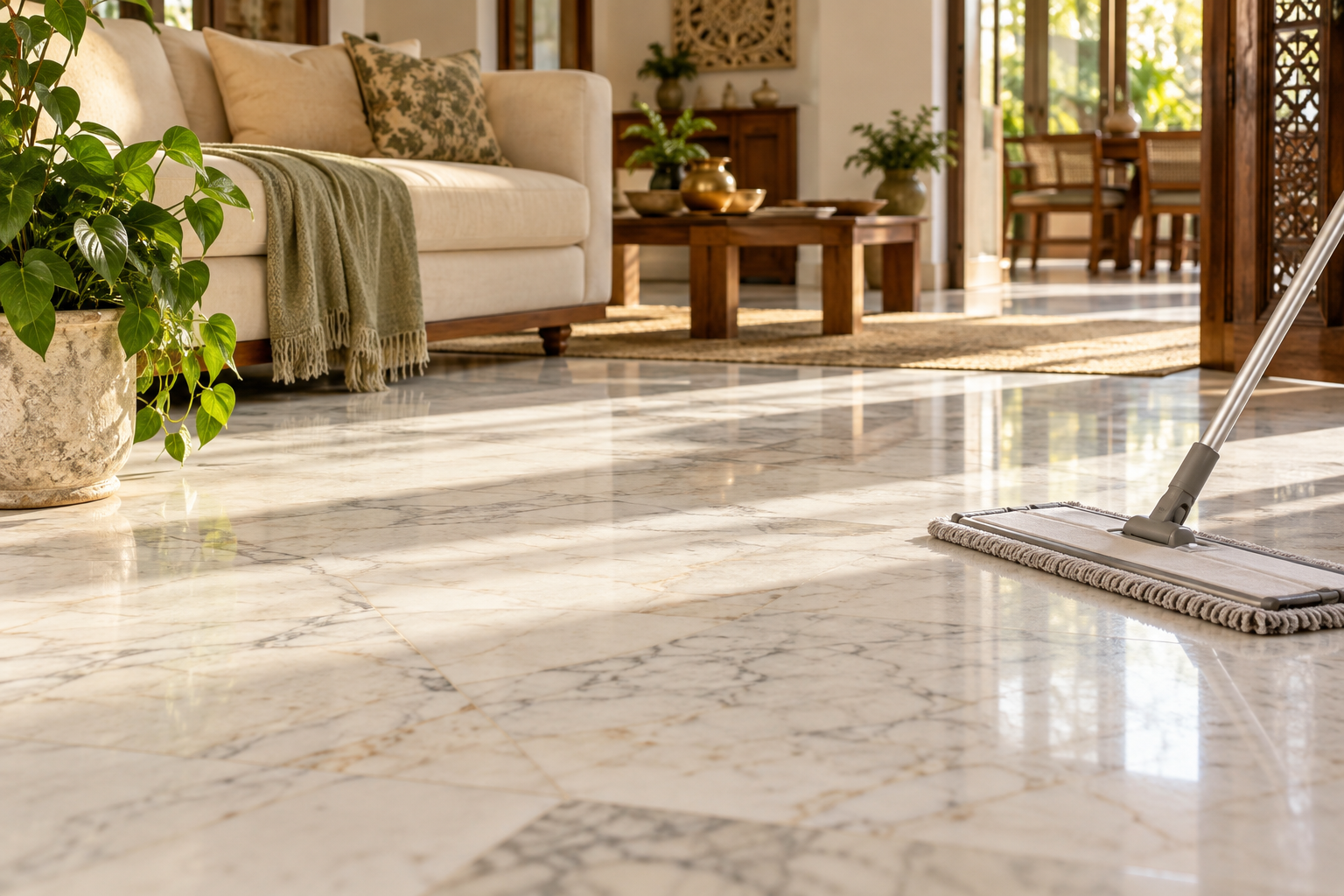
Marble can make a living room, foyer or hallway feel timeless. Its natural veining and polished finish are often a feature people want to preserve for years. Yet marble does not respond to every cleaning shortcut in the same way as ceramic tile or vitrified flooring. In Indian homes, where floors may be mopped daily and exposed to dust, footwear, cooking spills and festive cleaning, small choices can gradually affect the surface.
The good news is that marble care does not require an elaborate routine. It requires gentle cleaning, quick attention to spills and a cleaner that is confirmed as suitable for the stone. More product or harder scrubbing is not automatically better.
Why marble needs special care
Marble is a natural stone made mainly of calcium carbonate. Acids can react with it and leave a dull patch or change the polished finish. This damage is called etching; it is different from a stain. A stain is discolouration caused when a substance penetrates the stone, while etching changes the surface itself. Ordinary mopping may remove dirt, but it cannot reliably restore an etched finish. [1, 2]
That distinction matters. If a patch stays dull after cleaning, repeatedly scrubbing it may make the situation worse. First consider whether the mark could be residue, staining, scratches or etching. If you cannot identify the cause, ask a stone-care professional rather than experimenting with stronger chemicals.
Choose a cleaner for the stone, not just the dirt
For routine marble maintenance, established stone-care guidance recommends clean water or a suitable pH-neutral cleaner made for natural stone. [1] A product labelled for general floors should not automatically be assumed safe for marble. Read the full label and look for explicit compatibility with the particular surface.
Avoid vinegar, lemon juice, acidic descalers and toilet cleaners on marble. Do not use abrasive powders, steel wool or rough scouring pads on a polished finish. These methods may be useful for other jobs but can etch or scratch marble. “Natural” ingredients are not automatically suitable for every material.
LOCI Floor Cleaner is compatible for marble floor.
A practical everyday routine
Start by sweeping or dust-mopping. Fine grit and sand can act like abrasives when dragged across a polished floor under a mop or footwear. Use a soft broom or clean dust mop, paying particular attention to entryways and balconies.
Next, damp-mop rather than flooding the floor. For routine cleaning, LOCI Floor Cleaner is suitable for marble, granite, laminates, tiles and sealed stone surfaces. Dilute 2 capful (20 ml) in 14-15 litres of water and mop normally. Avoid leaving puddles, especially near joints, edges and places where water tends to collect.
No rinsing is required. Allow the floor to dry, and avoid adding extra cleaner in the hope of achieving a better shine. Using more than the recommended quantity is unnecessary and may leave residue.
The LOCI tip: A good cleaning routine is about removing everyday dirt consistently and using the recommended dilution—not using more product than necessary.
Handle common Indian household spills promptly
Tea, coffee, cooking oil, curry and turmeric can all mark stone, depending on the stone and its finish. Blot a spill rather than wiping it across a wider area. Lift food particles gently, then use a cleaner appropriate for marble and follow its directions.
For oily spills, absorb as much oil as possible before wiping. For turmeric or curry, remove the food residue promptly without using a rough scrubber. If an acidic liquid such as juice spills on marble, blot it immediately and gently wipe with water; do not apply vinegar or lemon as a remedy.
If a stain remains, stop before escalating to a stronger chemical. The mark may have penetrated the stone, or the surface may be etched. A specialist can recommend an appropriate treatment.
Be careful during festive deep cleaning
Before Diwali, Eid or a family gathering, it is tempting to use one strong cleaner across the entire house. Marble is a good reason not to do that. Toilet cleaners, descalers, concentrated general-purpose products and abrasive tools should not be used unless their instructions explicitly confirm suitability.
Some marble surfaces may benefit from an appropriate impregnating sealer, depending on the stone, finish and use. Sealing can improve resistance to certain stains, but it does not make marble stain-proof or protect it from acid etching. Ask the supplier or a stone-care professional whether sealing is appropriate. [1]
Where LOCI fits into a thoughtful routine
LOCI Floor Cleaner is suitable for marble and can be part of a regular cleaning routine to remove everyday dirt and grime. Use the recommended dilution and a soft mop to clean the floor without unnecessary scrubbing.
A well-maintained marble floor depends on regular dust removal, prompt attention to spills, gentle cleaning tools and consistent care—not a strong fragrance or aggressive scrubbing.
Frequently asked questions
Can I use vinegar on marble? No. Its acidity can etch and dull marble.
Why does my marble look dull after mopping? Possible causes include residue, scratches, wear or acid etching. The correct response depends on the cause.
Can I use LOCI Floor Cleaner on marble?Yes. LOCI Floor Cleaner is suitable for marble and can be used for everyday cleaning. For a floor area of 1,000 sq. ft. or more, use 2 capfuls in 14–15 litres of water for routine mopping.
How often should I mop marble? Sweep as needed and damp-mop when the floor needs it. Foot traffic, dust and household routines will affect frequency.
The takeaway: Marble needs gentle, informed care. Match the cleaner to the stone, follow the label, and stop treating every dull patch as ordinary dirt.